Odds of Winning Roulette: Nearly 50 Percent Roulette is a wheel with the numbers 1 - 36 on it in red and black, and the numbers 0 (and in American casinos also 00) in green. The croupier, or roulette dealer, spins the wheel and the ball falls on one of the numbers. There are a number of different ways that you can place roulette bets. Jun 18, 2019 The odds of winning can also be expressed in the same way. On a standard American roulette wheel, you have 37 ways to lose a single number bet and only one way to win. This means the odds of winning are 37 to 1. Since the odds of winning are lower than the payoff for the bet, the casino makes a profit in the long run.
Do you enjoy playing roulette? Do you enjoy winning? If you like roulette and want to win while playing you need to understand the odds.
Roulette odds of winning are determined by a number of factors. The main three factors are the numbers, your bets, and your system of play. In order to understand how each of these variables impact your odds, let’s take a look at them one at a time
Roulette Odds of Winning and the Numbers
The first thing that impacts your odds are the numbers. The good news is that roulette is a very basic game with easily calculable and standardized odds. These odds are found by taking the number of potential winning scenarios and dividing that number by the number of possible scenarios.
Before we look at the specific numbers, let’s look at the wheel. There are two main variations of the roulette wheel and they each have their own odds. The European wheel has 36 numbered slots with an alternating red and black pattern. The numbers are arranged in a pattern that keeps them mixed up. The wheel also has one green space on it. This space is number zero. When added up, there are 37 total spaces on the wheel.
On an American roulette wheel, there are the same number of red and black spaces although they are laid out in a different pattern. The main difference is the addition of a second green slot. There is still the green zero, but the American roulette wheel has a green double zero as well. There are a total of 38 colored and numbered spaces on the American wheel.
House Odds Roulette

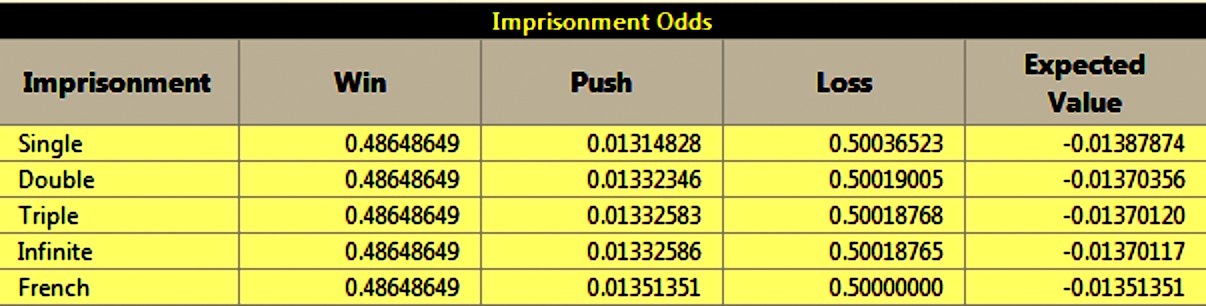
Since the odds are based on the number of positive situations divided by the number of potential situations, let’s look at an example. If you were betting a simple “Even” bet, you would be betting that the ball would land in any one of the red or black even slots. The green zero or double zero spaces do not count as an even or an odd space, but as a loss on all of these types of bets. This means that there are 18 even spaces on the wheel. On an American wheel, your odds of success are 18/38; 18/37 on a European wheel. In percents, you have a 47.37 percent chance of winning this bet on an American wheel and a 48.65 percent chance of winning with this bet on a European wheel.
Roulette Odds of Winning and Your Bets
In roulette odds of winning are not truly impacted by your betting strategy, but your odds of winning money are. The difference is that you can win a spin and still lose money. Consider the following scenario.
You put money $20 each on Red, Even, the first half numbers 1-18, and the individual numbers 2, 4, 6, 8, and 10. That’s a $160 worth of bets. The ball lands on red 27. You win the even money bet on red but lose the rest. You have effectively just lost $120 even though you “won” a bet.
It is very important to understand that roulette odds of winning do not change from spin to spin regardless of what the previous outcome was. Even if red is spun 80 times in a row, the next spin has the exact same odds that a red, black, or green will be spun. The same is true for evens, odds, or any of the individual numbers. If your betting strategy is based on a number or color “being due” or any other sort of fuzzy math, you will find that the odds do not work in your favor. After all, the house has an edge on each and every spin.
Roulette Odds of Winning and Your System of Play
As already mentioned, if your system of play is based on fuzzy math, you still have a chance of winning each and every time, but the house has the edge. In the end, they will own your bankroll unless you get really lucky. There is a system of play, however, that defeats the odds. It’s not a “secret system” or a “trick”, in fact, there are sites that promote this truth for free and offer aids in helping you use it. The system is called: science. That’s right, science, specifically physics, can beat the roulette wheel. The good news is that you don’t need to be a physicist to use the knowledge.
By learning a few simple methods of calculating where the ball is going to drop based on the spin speed of the wheel, wheel bias, a dealer signature, or ball bounce, you can greatly increase your odds of winning on many roulette wheels.
Computer software can increase your accuracy and speed and help you beat even more wheels, and roulette computers will beat most wheels in existence. Granted, you can’t get caught using them.
In short, roulette odds of winning are based on a number of factors, but the most important one is being able to shift the house advantage in your favor by using science to increase your chances of predicting the correct number the ball will land on.
First of all you should know that slot machines, as with many casino games, are a type of game for which there is no “winning strategy” - technically speaking they are a negative equity game, or –EV game for short. Unlike a game such as poker (against real opponents, not vs. the house) where proper application of skill can make a game profitable in the long-term, most casino games are designed to make this impossible.
Why Can’t I make a Consistent Return at Slots?
Let’s look at why, in the case of slots, there’s no way to make money long-term. For simplicity let’s imagine a game where there is only one pay-out, the “jackpot”, paid out for matching five symbols, of course the same logic will apply to complex modern machines as well. In this hypothetical machine there are five symbols available on each line and you need to match five of the same to win the jackpot on a $1 machine.
The lines are controlled by random number generators, and over time the five different symbols will come up equally often on each line. So the chance of hitting, say a cherry on one line is 1/5. The chance of hitting a cherry on the second line is also 1/5. Therefore the chance of hitting five cherries in a row is 1/5 x 1/5 x 1/5 x 1/5 x 1/5, or 1/3125, or 0.032%. Your odds of winning are better than this, as you can hit five bells, five whistles or five of any other set of symbols, so on this machine your odds of any set of five are actually 5 x 0.032%, or 0.16%. So once in every 625 spins of this hypothetical machine, you’ll hit your set of five identical symbols for the jackpot.
Now if the jackpot payout was $625, the machine would be a break-even proposition, as on average you’d pay $1 624 times without winning anything, and then you’d hit once in every 625 spins for the $625 prize, breaking even overall. Of course pay-outs are set by the casinos at a slightly lower figure, usually between 90% and 98% of this frequency, so for example if this imaginary machine was set for 95% pay-outs, the jackpot would actually be $594.
Of course you can get lucky and hit jackpot on your second spin, walk away and keep the money, technically making a profit. But long-term there’s no way to beat the law of averages, and the house edge will be sustained over any short-term variance in results. Rarely, certain machines are reported as paying out just above 100% over a given month, but this is again just the variance inherent in randomness, and will not be sustained over larger samples.
There’s a very nice little piece of software providing virtual testing of this principle, to be found here at Vegas Click. It simulates the return over one wager, over ten, a hundred, a thousand, ten thousand and a hundred thousand wagers, of a bet subject to a house edge, and shows the returns expected in each simulation. Try it out for yourself - it’s cheaper than going to Vegas!
A slot machine house edge is known by casino managers as the “hold”, and hold percentages vary a great deal, and do tend to be smaller at more expensive slots, frequently found to be around 1- 3% at the five dollar slots. Of course, percentage of investment lost is not a real money figure, and you’ll still tend to lose more money in real terms at the more expensive machines, since you’re putting far more money through the machine each hour.
Why Play if There’s a House Edge?
Certainly you shouldn’t be playing in order to try to make sustainable returns. Of course many people enjoy the thrill of a gamble, even if they know or merely suspect that it’s a negative equity investment of their money. Of course, there’s always the chance you may get lucky, even astoundingly so, as some winners of multi-million dollar slots jackpots can certainly attest to. There’s also the enjoyment factor, and playing slots can be a cheap form of entertainment if you stick to a budget and if you actually do genuinely enjoy it!
What is the Exact Edge on a Particular Machine?
There’s an easy answer to this one – you frequently can’t find out. Certainly it’s against a casino’s interests to publish this information on the front of a machine, and I’m sure many gambling-happy players don’t even realise there is a real house edge, nor know the difference between a game of skill and one of pure luck. Monthly and annual reports are regularly published of the actual pay-outs for given machines, so do your research and you could get a good idea.
Certain states in the US require the pay-outs to be in a certain range (typically above 80%), and this can be discovered with a bit of trawling through your state’s gambling laws. For example in Nevada, the gaming board states that the machines must have a RTP of 73% while in Mississippi, it is 80%.
Odds Of Winning Slots
A good rule of thumb is that higher cost games tend to have a smaller house hold percentage, but it’s likely to always be at least 1-3 %.
You might also want to consider your likely loss over an hour of play at different denominations.
Busting Slot Machine Myths
As with many a casino game, myths and falsehoods abound, and there are many people who think they have a stone cold strategy for beating slots and other casino games. These people are usually either lying, or deluded. If they’re trying to sell you a system, it’s most likely the former. Unless you have some kind of technology which can control or damage a slot machine directly, you can’t beat the machine long-term.
Of course anything along those lines would be straight up cheating. There’s no wagering system which will allow you to beat the house edge in slots, although there are systems which will allow you to lose the minimum – with slots this essentially comes down to choosing machines found to have a smaller hold percentage, and playing maximum wagers at all times, to enable you to at least hit the full jackpot when your luck does come around.
Many people believe that machines run on hot and cold cycles. This is a myth, random number generators are programmed to function on individual spins, and there is no “machine memory” of previous spins, each one being an isolated event. The same principle applies to tossing a coin. Throwing ten heads in a row doesn’t increase the chance of hitting tails the next time. Each throw is an individual probabilistic event, 50/50 with a true coin.
One myth with a modicum of truth to it is that the casino can alter pay-outs and other factors remotely. While untrue in the vast majority of cases, server controlled machines are gaining in popularity amongst casinos, although many establishments have rules about how and when settings can be changed, usually this only occurs between bouts of play, and a message should generally appear on the screen during the process, stating that remote control is in progress. For a non-server controlled machine to be altered in any way would involve physically opening the machine up and amending the EPROM chip within.
Further Advice for Playing Slots
Odds Of Winning On Roulette Machine Cheats
Some games do feature a skill bonus round or skill component which can improve your odds. Of course these are also set up so as not to obliterate the house edge, so they aren’t going to be sufficient to give you a real long-term return, but the advice on how to play these rounds offered by the machines should usually be adhered to for maximum benefit.
Finally if you’re playing for fun (really the only reason to play slots), play slowly. You’ll save money.